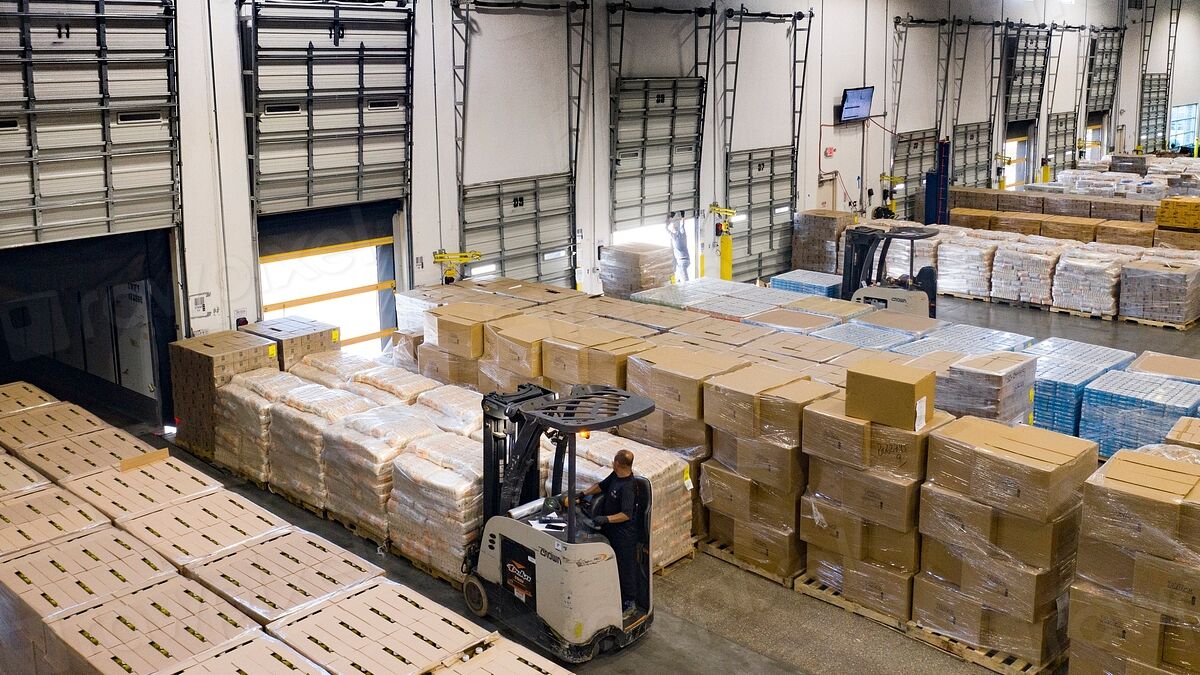
The Food-Link Fund is a new $1 billion, 10-year federal fund to build up Canada's food distribution system. Its Food Hub Program, run by Agriculture and Agri-Food Canada (AAFC), can contribute up to $25 million per organization to establish, expand or modernize food hubs that store, aggregate, process and distribute local food.
Every project starts with one Food-Link Fund Expression of Interest, open October 14 to December 11, 2026 at 11:59 pm Pacific Time. AAFC says the window may close sooner if funding is fully committed. Until October 14, the program page shows the intake as closed because it has not opened yet.
This guide is for food processors, distributors, logistics firms, independent grocers, co-ops and community food organizations. It covers who qualifies, how the cost share works, when the money is repayable, and what to have ready before the window opens.
Food-Link Fund at a glance
The Food-Link Fund has two programs. AAFC delivers the Food Hub Program covered here. The Food Terminal Fund, for large wholesale food terminals, is delivered by Housing, Infrastructure and Communities Canada (HICC). You do not choose between them up front: you submit one Expression of Interest and the government routes the project to the program that fits.
What the Food Hub Program is for
The Food-Link Fund aims to strengthen competition in a highly concentrated retail market, improve distribution efficiency, lower food costs, and support consumers, independent grocers and producers. The Food Hub Program's piece of that is regional infrastructure, equipment and logistics that connect local producers to markets. AAFC lists three objectives:
- Expand, modernize or establish food hubs that improve the storage, aggregation, processing and distribution of food
- Invest in regional infrastructure, equipment and logistics capacity that connects local producers and makes supply chains more efficient
- Lower barriers to entry for small and medium-sized businesses and increase competition in regional food systems
The National Food Security Strategy says the funding will support the establishment of up to 20 to 40 hubs, with a target of 10 food hubs established or expanded by the end of 2028. That is a small number of awards for a national program, which is why project readiness matters so much here.
Who can apply
AAFC's eligible applicant types are:
- For-profit organizations incorporated in Canada, including corporations, partnerships and co-operatives. AAFC's examples: small and medium-sized processors or distributors, logistics firms and independent grocers
- Not-for-profit organizations, including industry associations, co-operatives, and local community, charitable or voluntary organizations. AAFC's examples: producer co-operatives and regional food hubs
- Provincial, territorial or municipal governments and agencies with a commercial operating model or a private sector partner
- First Nations, Inuit and Metis communities, governments, not-for-profits and for-profit organizations
You must also be involved, or appropriately placed to become involved, in aggregating, processing, storing and distributing locally grown or processed food, and be a legal entity able to sign a binding agreement. Financial institutions, academic and educational institutions, foreign governments and foreign organizations are not eligible.
No size test. AAFC has not published any revenue, headcount or years-in-business threshold. The practical filter is financial: you need your share of the project secured before you apply, and the full application asks for a business plan and up to 2 years of financial statements.
What it pays for
Eligible activities relate to establishing or expanding a food hub. AAFC lists:
- Buying or upgrading equipment to collect, aggregate, store, analyze (quality control), process, pack, sell, distribute or transport food
- Digital infrastructure, including supply chain management, e-commerce and point-of-sale (POS) platforms
- Construction, expansion, building retrofit or modernization of facilities
- Feasibility studies and supply chain mapping that include operational improvements
- Food safety and traceability improvements, grading and sorting, packing and labelling, producer onboarding and coordination, and market development
- Materials and supplies for infrastructure projects, such as installing funded equipment
Eligible cost categories
- Capital expenditures: buildings, facility expansion and modernization, equipment, commercial vehicles and machinery, and specialized software including POS. Each must be directly required for the project, not for resale, have a useful life over 1 year, and cost more than $10,000 per item or cumulatively. Installation, freight, transport insurance and duties count as part of the cost
- Contracted services: consultants, experts and project management for project activities, under a written contract and selected through a fair and competitive (or otherwise justifiable) process
- Salaries and benefits: only incremental staff time on the project, backed by timesheets; benefits capped at 25% of eligible salary; no bonuses or severance
- Administration: a flat 10% of total eligible costs, subject to the cost share, with no itemizing or claim validation required (you can opt out)
- Other direct costs: feasibility studies and supply chain mapping, equipment rental or lease, goods and shipping, and materials and consumables
What it does not pay for
The purchase of food is ineligible. So are travel, hospitality, goodwill, legal fees, contingency, costs that are part of normal business practice, application preparation costs, the recoverable portion of GST/HST, amounts above fair market value, non-cash costs such as amortization, and any cost already reimbursed under another federal, provincial or territorial program.
Repayable or non-repayable: read this before you budget
The Food Hub Program is a contribution program, not a straight grant. AAFC sets out when the money has to be paid back:
- Non-repayable when the project contributes to benefits that accrue broadly rather than primarily to the recipient
- Repayable when the recipient is a for-profit business and the contribution is primarily intended to let it generate profits or increase the value of the organization
Repayable contributions are interest-free (except on late payments or debts owed to the Crown), normally repaid over up to 10 years after the project is complete, with payments normally starting 1 year after completion. The amount and schedule are set in the contribution agreement.
In practice: if you are a private processor or distributor expanding your own capacity, plan your cash flow as if the contribution is repayable. An interest-free, 10-year contribution is still valuable capital, but it is not free money. A shared hub run by a co-op, not-for-profit or Indigenous organization, or a project whose benefits clearly reach many producers and independent retailers, has a stronger basis for a non-repayable contribution. AAFC decides this case by case, and its assessment also looks at your capacity to repay where a repayable contribution applies.
How the cost share works
AAFC normally covers up to 50% of eligible costs and you cover at least 50%. If your organization is majority owned or led by Indigenous Peoples, youth (35 or younger), women, visible minorities, persons with disabilities or 2SLGBTQI+ people, AAFC can cover up to 60% and your minimum drops to 40%. For companies, AAFC generally looks at shareholders; for boards and similar groups, it looks at leadership.
On top of that, total government funding from all sources (federal, provincial, territorial, municipal, agencies and Crown corporations) cannot exceed 85% of total project funding. For Indigenous applicants the cap is 100% of eligible costs.
Two rules make the match harder than it looks. Your share must be secured before you submit an application, and any third-party financing cannot be conditional on AAFC approval. A bank term sheet that only closes if AAFC says yes does not count.
How to apply: two stages
- Expression of Interest (October 14 to December 11, 2026). Sign in to AAFC's online services through the Grants and contributions option, download the Food-Link Fund Expression of Interest form, complete it, upload it with any extra information and the pre-screening details, and submit. The form has 7 sections: title, description, start and end dates, project information, requested federal funding and primary contact. Hand-written applications are not accepted.
- Routing. Food hub projects stay with AAFC and may be invited to apply. Projects that fit the food terminal criteria are transferred to HICC.
- Full application (by invitation). Completed online within 1 year of the invitation, with a 10-section form and the supporting documents listed below.
- Review and decision. AAFC aims to acknowledge receipt within 1 business day and issue a decision within 100 business days of a complete application. Approved projects then negotiate a contribution agreement.
The project information section of the Expression of Interest asks for a lot more than a summary: how the project increases the availability of domestically grown food, the services you will provide, whether you are shovel-ready, the geographic area served, whether you are expanding or starting new, how the hub stays viable without ongoing federal funding, the total cost and how much is confirmed or pending from each source, the partners involved, and the evidence of need and market demand (letters of intent from producers and buyers, a defined service area, what existing distributors already cover, and how you will handle seasonal gaps).
What to prepare before October 14
If you wait for the window to open before you start, you will be writing a business case against a clock that may close early. Get these ready now:
- A defined project and budget. What you will build or buy, where, and when, with supplier quotes or estimates for all construction, renovation, equipment and technology. AAFC scores whether the budget is supported by quotations
- Your secured share. Board resolution, bank statements, signed financing agreements or letters of financial support, and term sheets that are not conditional on AAFC
- Demand evidence. Letters of intent from producers who will supply the hub and from buyers (independent grocers, restaurants, institutions) who will buy from it, plus a realistic service area
- A business plan with 10-year projections. The full application asks for the applicant profile, corporate structure, shareholders over 10%, board, strategic plan, financial status, project financing plan, 10 years of incremental revenue and expenses, need for the contribution, market analysis, management capacity, and risks with mitigation
- Financial statements. Audited or review engagement statements (balance sheet, income statement and cash flow) for the past 2 years, or since start-up, plus the latest interim statements, as applicable
- Corporate and site documents. Articles of incorporation, organizational chart, corporate structure diagram, any regulatory permits, inter-company agreements, a landlord letter if you do not own the site, and a Band Council Resolution for First Nations communities
Cost eligibility date. In the first program year (2026-27), costs can be eligible back to June 11, 2026. Costs incurred before a contribution agreement is signed are entirely at your own risk: AAFC cannot reimburse anything until the agreement is in place, and approval is never guaranteed.
How AAFC will assess projects
AAFC gives priority to projects with the greatest potential benefits. The published criteria include:
- Alignment with program objectives: more food distribution infrastructure, more competition and access to local food (measured by new and returning customers), stronger supply chains, and a more resilient food supply. Where possible, show how you address food waste and food rescue, and whether you serve a priority population or underserved region
- Capacity: the technical, financial and managerial ability to deliver on time and on budget, your capacity to repay where applicable, project readiness, and your ability to keep operating without ongoing program support
- Quality of the application: eligible and reasonable activities, a feasible and sustainable project, and a budget supported by quotes
- Wider policy fit: the National Food Security Strategy, Canadian sourcing where feasible, impact on underrepresented groups and underserved areas, and capacity to serve institutional buyers such as school food programs
The intake is competitive and discretionary. Program staff will clarify the guidelines by email but will not comment on specific proposals or drafts.
Why applying early matters
AAFC states that the intake period may close sooner than December 11 if funding is fully committed. The National Food Security Strategy also says the funding will support only 20 to 40 hubs in total. Both point the same way: a complete, well-evidenced Expression of Interest submitted in the first weeks of the window is in a better position than a rushed one in December.
Early does not mean thin, though. The Expression of Interest is AAFC's first screen for eligibility and fit. If your match funding, demand evidence and quotes are not in place, use the time before October 14 to get them, rather than submitting on day one with placeholders.
Common mistakes to avoid
- Counting on financing that only closes if AAFC approves the project
- Assuming a for-profit expansion will be non-repayable
- Budgeting for food purchases, travel, legal fees or contingency, none of which are eligible
- Listing capital items under the $10,000 threshold as capital costs
- Claiming costs that another government program is already reimbursing
- Describing the project only as company growth, instead of showing how producers, independent retailers and communities benefit
- Starting construction before a signed agreement without accepting that the cost is at your own risk
Frequently asked questions
What is the Food-Link Fund?
A $1 billion, 10-year federal fund (2026-27 to 2036-37) launched October 5, 2026 under the National Food Security Strategy. It runs through two programs: AAFC's Food Hub Program and the Food Terminal Fund delivered by Housing, Infrastructure and Communities Canada.
How much can one organization get from the Food Hub Program?
AAFC may contribute up to $25 million per organization over the life of the program, normally up to 50% of eligible costs, or up to 60% for organizations majority owned or led by underrepresented groups. No per-project minimum or maximum is published.
Is the Food Hub Program a grant or a loan?
It is a contribution that can be either. It may be non-repayable when the project's benefits accrue broadly rather than primarily to the recipient, and repayable when a for-profit recipient's contribution mainly generates profit or increases the value of the organization. Repayable contributions are interest-free, normally repaid over up to 10 years, starting about 1 year after completion.
When is the Food-Link Fund deadline?
The Expression of Interest is open October 14 to December 11, 2026 at 11:59 pm Pacific Time. AAFC says it may close sooner if funding is fully committed. Invited applicants then have up to 1 year to submit the full application.
Can independent grocers apply?
Yes. AAFC names independent grocers, small and medium-sized processors and distributors, and logistics firms as examples of eligible for-profit applicants, as long as they are incorporated in Canada and are involved, or placed to become involved, in aggregating, processing, storing and distributing local food.
Can I combine the Food Hub Program with provincial funding?
Yes, within limits. Total government funding from all levels cannot exceed 85% of total project funding (100% of eligible costs for Indigenous applicants), and costs reimbursed under another federal, provincial or territorial program are not eligible.
Do I need my matching funds in place before I apply?
Yes. AAFC requires your financial contribution to be secured before you submit an application, and third-party funding cannot be conditional on AAFC approving the project.
Planning a food hub project?
GovMoney helps Canadian agri-food businesses and community food organizations scope projects, line up matching funds and prepare clear, well-evidenced applications. Book a call and we will look at whether the Food Hub Program fits and what to prepare before October 14. Program questions can also go to AAFC at aafc.fhp-pca.aac@agr.gc.ca or 1-877-246-4682; see the official how-to-apply page.
Book a free 30-minute consult →