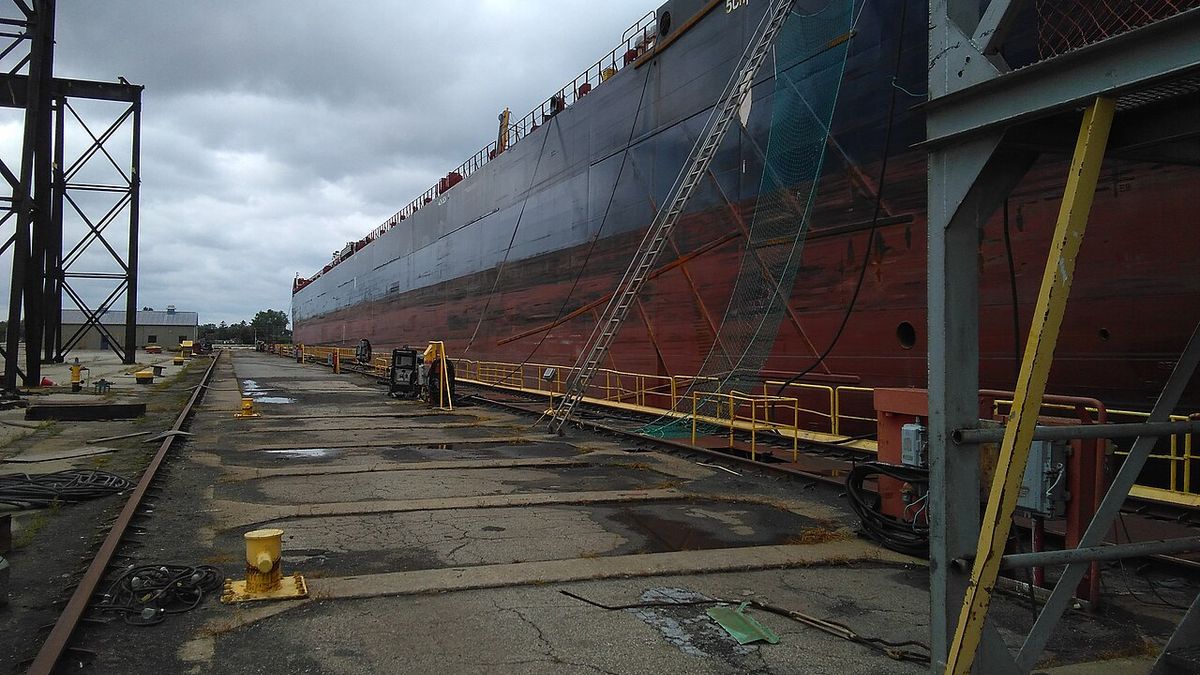
The Ontario Shipbuilding Grant Program (OSGP) is open for its 2026 intake. Applications go through Transfer Payment Ontario and are due by November 19, 2026 at 5:00 p.m. Eastern time. The program funds up to $7 million per project for Ontario shipbuilders and the companies that supply them, covering up to 50% of total eligible expenditures.
This is a capital and capacity program, not a research credit. It pays for shipyard infrastructure, machinery, digital systems, training and specialized services that move a business forward. It also pays by reimbursement, so your cash flow plan matters as much as the project itself.
Below is how we would approach the intake with a client today: who qualifies, how to scope a project that scores well, what to have ready before you open the application, and a working schedule for the weeks left. Nothing here guarantees funding. The ministry evaluates each application on its merits. For the program record and key dates, see our Ontario Shipbuilding Grant Program page.
OSGP at a glance
OSGP is administered by the Ontario Ministry of Transportation.
The guidelines do not say when funding decisions will be made.
Who should apply
You need to be an incorporated, for-profit business legally established under the laws of Canada or Ontario, or an Indigenous Business, and you need to be located and operating in Ontario. An Indigenous Business for this program is 51% or more owned and controlled by an Indigenous person or persons and, if it has six or more full-time staff, at least one-third of its employees are Indigenous persons.
The test that decides most files is revenue. At least one-third of your annual business revenue must come from Shipbuilding or the Shipbuilding Supply Chain in at least one of your last three fiscal years. Shipbuilding means construction, refit, retrofit, repair and/or maintenance of marine vessels for commercial, research, passenger transportation or other special purpose uses, such as search and rescue or national defence. Supply chain means companies that manufacture or provide components, technologies, systems and specialized services that directly support shipbuilding. The work has to be functionally and specifically linked to shipbuilding processes and vessel life cycle needs. Selling general industrial parts that occasionally end up in a ship is a hard argument to make.
Illustration only. A machining company had $9,000,000 in revenue in one of its last three fiscal years. Of that, $3,200,000 came from components made to order for vessel refits. One-third of $9,000,000 is $3,000,000. Since $3,200,000 is more than $3,000,000, the company meets the test for that year (3,200,000 / 9,000,000 = about 35.6%). It should be able to show that split from its own records.
Not eligible: unincorporated businesses, non-profits, businesses outside Ontario, businesses in or preparing for closure, dissolution, bankruptcy or sale, and businesses involved in, or projects related to, watercraft for tourism or personal or private recreational use, such as jet skis or recreational boats.
How to scope a strong project
Start with the program objectives. Your project must align with at least one: enhance operational efficiency, productivity or economic competitiveness; unlock business growth or new business opportunities; enhance long-term manufacturing or organizational capacity; or support defence innovation and supply chain resilience. Pick the ones you can prove.
Then look at how the ministry scores. Impact and Benefits carries 35% of the evaluation and Performance Measures another 20%. More than half the score sits in what the project changes and how you will measure it. A new dry dock or CNC cell is a purchase. A strong application explains what that purchase lets you do that you cannot do now, and gives measures you can report on, including the estimated full-time equivalent jobs created during the project build or implementation phase (not ongoing or permanent jobs after completion), with a supported explanation.
Build the budget only from eligible categories:
- New shipyard infrastructure (purchase, construction, installation) and facility modifications or upgrades
- New or refurbished machinery and equipment
- New digital equipment, software and licensing
- Workforce training: enrolment at recognized institutions, on-site employer-led training, development of training materials
- Third-party consulting and professional services
- Municipal permits, inspections and fees
- One-time internal labour to set up or install equipment, technology or systems for the project, capped at 5% of total eligible expenditures
Two rules trip people up. First, internal labour is capped at 5% of total eligible expenditures and must be one-time; ongoing salaries and benefits are ineligible. Second, equipment, technology or infrastructure built into your final commercial products is ineligible. The grant supports the capacity to build, not the components you sell.
Keep the project inside three fiscal years. Longer projects are ineligible, so phase anything larger and apply for the part you can finish.
The funding math
Illustration only. A project with $14,000,000 in total eligible expenditures. At 50%, OSGP could reimburse up to $14,000,000 x 50% = $7,000,000, which is exactly the per-project cap. Your mandatory contribution is at least $14,000,000 x 25% = $3,500,000 from your own funds. That leaves $14,000,000 minus $7,000,000 minus $3,500,000 = $3,500,000 still to be funded.
That remaining amount has to come from somewhere. The simplest answer is more of your own money. Be careful with other funding: total funding from all provincial sources cannot exceed 50% of total eligible expenditures, and costs funded or reimbursed by third parties or other government sources are ineligible. If you expect other funding to touch the same project, confirm with the ministry at marine@ontario.ca how it affects your eligible budget before you rely on it.
Above $14,000,000 the cap governs. As a further illustration, on a $20,000,000 project, $20,000,000 x 50% would be $10,000,000, but the grant still stops at $7,000,000, which is $7,000,000 / $20,000,000 = 35% of the total. And 50% is a ceiling, not a promise.
Cash flow needs its own plan. OSGP pays by reimbursement: you incur and pay the costs first, then claim. Instalments are quarterly or semi-annual, and each payment carries a 10% holdback that is released only after the project is complete and all obligations are fulfilled.
Illustration only. Suppose you pay $2,000,000 of eligible costs in a quarter and the program share is 50%. The claim would be $2,000,000 x 50% = $1,000,000. With the 10% holdback, $1,000,000 x 10% = $100,000 is held back and $900,000 is paid. You carried the full $2,000,000 until that payment arrived.
Before you apply, talk to your bank about bridging the gap between paying suppliers and receiving reimbursement, and model the holdback through to project close.
What to prepare
- Financial statements for each of the previous three fiscal years, either audited (preferred) or review engagement, prepared under IFRS or ASPE, including a balance sheet, income statement and cash flow statement.
- Articles of incorporation and/or letters patent.
- Tax Compliance Verification (TCV) certificate. The guidelines point to Ontario's tax compliance status check for generating a TCV number. Get it early.
- Letters of support from each project partner, if you have partners.
- Supplier quotes (our recommendation, not a listed requirement) for equipment, construction, software and services, so every budget line traces to a document.
- Revenue breakdown (our recommendation) showing the shipbuilding or supply chain share for the year you rely on.
The application itself asks for a work plan, budget, risks and mitigation, and performance measures. Write them as one connected story so the numbers match across sections.
You need a Transfer Payment Ontario (TPON) account to apply. Set it up early rather than in the final week.
Common mistakes
- Assuming you qualify without checking the one-third revenue test against your actual financial statements.
- Including ongoing salaries or benefits. These are ineligible, and internal labour is limited to one-time work up to 5% of total eligible expenditures.
- Budgeting for land or building purchases, lease or rent, general maintenance, facility operating fees, insurance, travel, food, legal and audit fees, debt service, or HST. All are ineligible.
- Claiming equipment or technology that becomes part of the product you sell.
- Scoping a project that runs past three fiscal years.
- Writing a strong equipment list and a weak impact section, when Impact and Benefits is 35% of the score.
- Giving job estimates without a supported explanation of how you arrived at them.
- Spending money before the Eligible Expenditure Period in your Transfer Payment Agreement. Costs count only within that period, which is set in your Transfer Payment Agreement.
A realistic timeline to November 19
This is a suggested plan, not a program requirement. It assumes you start today, October 6.
- Weeks 1 and 2 (October 6 to 19): confirm eligibility and the revenue test, register in TPON, request the TCV certificate, gather three years of statements and corporate documents, and pick the objective your project serves.
- Weeks 3 and 4 (October 20 to November 2): collect supplier quotes, build the budget from eligible categories, check the 5% internal labour cap, confirm your 25% contribution and cash flow plan, and request partner letters.
- Week 5 (November 3 to 9): write the work plan, risks and mitigation, performance measures and the impact and benefits narrative, including your FTE estimate and how you got there.
- Week 6 (November 10 to 16): internal review by someone who did not write it, reconcile every number across sections, and fix gaps.
- Final days (November 17 to 19): upload, check attachments, and submit well before 5:00 p.m. Eastern time on November 19. You only get one application.
Frequently asked questions
Can a recreational boat builder apply to OSGP?
No. Businesses involved in, or projects related to, watercraft for tourism or personal or private recreational use, such as jet skis or recreational boats, are excluded.
How much can OSGP fund?
Up to $7 million per project, covering up to 50% of total eligible expenditures. You must contribute at least 25% of total eligible expenditures from your own funds.
Can the grant pay for our employees' wages?
Employee and executive salaries and benefits are ineligible. One-time internal labour to set up or install equipment, technology or systems for the project is eligible, capped at 5% of total eligible expenditures.
Can we stack OSGP with other funding?
Total funding from all provincial sources cannot exceed 50% of total eligible expenditures, and costs funded or reimbursed by third parties or other government sources are ineligible. Contact marine@ontario.ca about your specific situation.
Do our financial statements need to be audited?
Not necessarily. Audited statements are preferred, but review engagement statements are accepted. You need statements for each of the previous three fiscal years, prepared under IFRS or ASPE, including a balance sheet, income statement and cash flow statement.
When will we find out if we are approved?
Successful applicants are notified in writing. The ministry has not published decision timing.
Applying to the Ontario Shipbuilding Grant before November 19?
We help Ontario shipbuilders and marine suppliers test eligibility, scope the project and build a Transfer Payment Ontario application that holds together, alongside SR&ED and the other programs you may already use.
Book a free 30-minute consult →